The Things I No Longer Buy: Soda Pop
How an old-fashioned fermentation method turned my garden into a soda fountain.
There was a time when a cold bottle of soda was something special.
It was sweet. It was bubbly. It was refreshing. And somewhere along the way, it became so ordinary that we stopped thinking much about what was actually inside the bottle.
But if you have followed my series The Things I No Longer Buy, you already know that I love asking a different question:
Could I make this myself?
And, perhaps more importantly:
Could I make something better?
When I began looking into soda pop, I discovered that the answer was a very enthusiastic YES!
Today, I make my own sodas from herbs, roots, flowers and spices—even plants growing right outside my door.
But before I show you what replaced soda in my home, let’s go back to where soda began.
Soda Wasn’t Always What We Drink Today
The story of soda begins with carbonated water. By the 1800s, soda fountains were becoming popular, particularly in pharmacies, where sparkling water was combined with flavored syrups and other preparations.
And that brings us to perhaps the most famous soda of all.
Coca-Cola was invented by a pharmacist.
In 1886, Atlanta pharmacist Dr. John Stith Pemberton created a syrup and carried it to Jacobs’ Pharmacy, where it was combined with carbonated water and sold for five cents a glass.
His bookkeeper, Frank Robinson, came up with the name Coca-Cola and penned the distinctive script still recognized around the world today.
During its first year, Coca-Cola averaged only about nine drinks sold each day.
That certainly didn’t last!
Over time, soda changed from an occasional treat at the local soda fountain into something we could keep by the case in the pantry, grab from a vending machine and drink every day.
So What’s Actually in That Can?
Let’s look at an ordinary 12-ounce Coca-Cola.
According to Coca-Cola itself, it contains 39 grams of sugar—nearly 10 teaspoons.
Stop for a moment and picture that.
Put ten teaspoons of sugar into a little bowl.
Would you normally sit down and eat it?
Probably not.
But dissolve it into a cold, fizzy beverage and suddenly it becomes very easy to consume.
Regular consumption of sugar-sweetened beverages has been associated with health concerns including weight gain, Type 2 diabetes, cardiovascular disease and tooth decay.
So I decided there had to be a better way.
And there is.
What If Your Soda Started in the Garden?
This is the part I love.
Instead of asking:
“What soda should I buy?”
I started asking:
“What is growing around me?”
Peppermint? Ginger? Hibiscus? Pine needles? Roots? Flowers? Spices?
You can begin with an herbal tea and turn it into a wonderfully refreshing fermented soda.
Think about that.
You can walk into your garden, harvest an herb, brew it into tea and—with a little help from some very industrious microorganisms—turn it into soda.
Your garden becomes your soda fountain.
Peppermint makes an incredibly refreshing cold soda. Hibiscus produces a gorgeous ruby-colored drink. Ginger gives you that wonderful spicy bite associated with old-fashioned ginger beer. Properly identified wild edible plants can open up even more possibilities.
How I Make Homemade Fermented Soda
The basic process is surprisingly simple.
First, I brew a strong herbal tea and sweeten it more than I would ordinary drinking tea. That sugar isn’t there only for sweetness—it provides food for the microorganisms responsible for fermentation.
Once the tea has cooled, I add:
⅛ teaspoon ACTIVE, BUBBLY sourdough starter per gallon.
Don’t have a sourdough starter yet? No problem! Learn how to make your own sourdough starter here. It’s easier than you might think—and once you have one bubbling away in your kitchen, you can use it for much more than bread!
Yes.
Sourdough starter!
I allow the sweetened tea and starter to “work” overnight. The next morning, I pour the soda into bottles, seal them, and leave them at room temperature while carbonation develops.
Once sufficiently carbonated, the bottles go into the refrigerator, where the cold greatly slows fermentation.
Don’t Be Tempted to Add More Starter!
I know what you’re thinking.
⅛ teaspoon? For an entire gallon?
It doesn’t look like enough.
I’ve made the mistake myself of thinking, Surely a little more would be better.
Trust me.
It isn’t!
What matters is not using more starter. It is using ACTIVE, BUBBLY starter.
That tiny amount is introduced into a gallon of sweetened tea and given an enormous banquet. Those microorganisms begin multiplying.
Adding too much starter can make your soda ferment too aggressively, develop an overly yeasty flavor, and build excessive carbonation.
And if you really overdo it?
You carefully chill your beautiful soda, open the bottle…
And it starts coming out.
And coming out.
And coming out.
By the time your soda volcano finally stops, most of your drink is on the counter!
So remember:
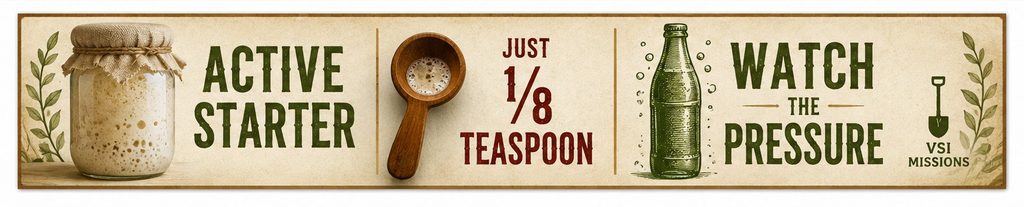
If your starter isn’t active, don’t add more.
Feed it. Wake it up. Wait for those bubbles.
My One-Plastic-Bottle Trick
I use glass bottles for my soda—with one exception.
Every batch gets one reused plastic water or soda bottle.
Why?
Because I can squeeze it.
When I first fill that plastic bottle, it has some give. As carbonation builds, it becomes firmer. That one bottle gives me a simple way to gauge what is happening inside all the glass bottles sitting beside it.
And trust me—you want one.
A friend once filled her pantry with bottles of kombucha and then left on vacation with her husband, leaving their two high-school-aged daughters home.
In the middle of the night…
BANG! BANG! BANG!
The kombucha bottles had begun exploding.
The poor girls thought it sounded like gunfire inside the house!
Fermentation is wonderful.
Fermentation is delicious.
Fermentation also occasionally likes to remind us that it is ALIVE.
A Quick Safety Note
Fermentation creates gas, and sealed bottles can build considerable pressure. Use bottles suitable for carbonated beverages, monitor them carefully, refrigerate once adequately carbonated, and open them cold and cautiously.
Fermentation speed varies with temperature and starter activity, so watch your ferment rather than relying entirely on the clock.
Yeast fermentation can also produce some alcohol along with carbon dioxide, so naturally fermented homemade soda should not automatically be considered alcohol-free.
Why I Prefer Kombucha Bottles
Many home fermenters love flip-top glass bottles.
I prefer sturdy reused kombucha bottles.
They’re strong, their screw-top lids seal well, and they’re short enough to fit nicely in my refrigerator.
But there’s another advantage.
If my soda becomes a little too carbonated, I can slowly turn the screw cap and gently release some pressure.
With a flip top, there isn’t much negotiating.
You flip it and…
POP!
And believe me, those things know how to pop!
From Herbal Tea to Living Soda
Perhaps my favorite thing about homemade soda is that it begins with plants.
The herbs, roots, flowers and spices aren’t merely flavorings. They are the foundation of the drink.
Fermentation can transform foods in fascinating ways, and in some foods microbial activity can improve digestibility or the availability of certain nutrients.
The microorganisms are also consuming some of the sugar we added. Exactly how much remains depends on the recipe and fermentation conditions, so I don’t give an exact finished-sugar number without testing. However, I have seen some recipes on-line claiming that only around 1 teaspoon of sugar remained (per serving) after the fermentation process was complete!
But the important principle is this:
The sugar isn’t there merely to make the drink extraordinarily sweet. It is also food for the fermentation.
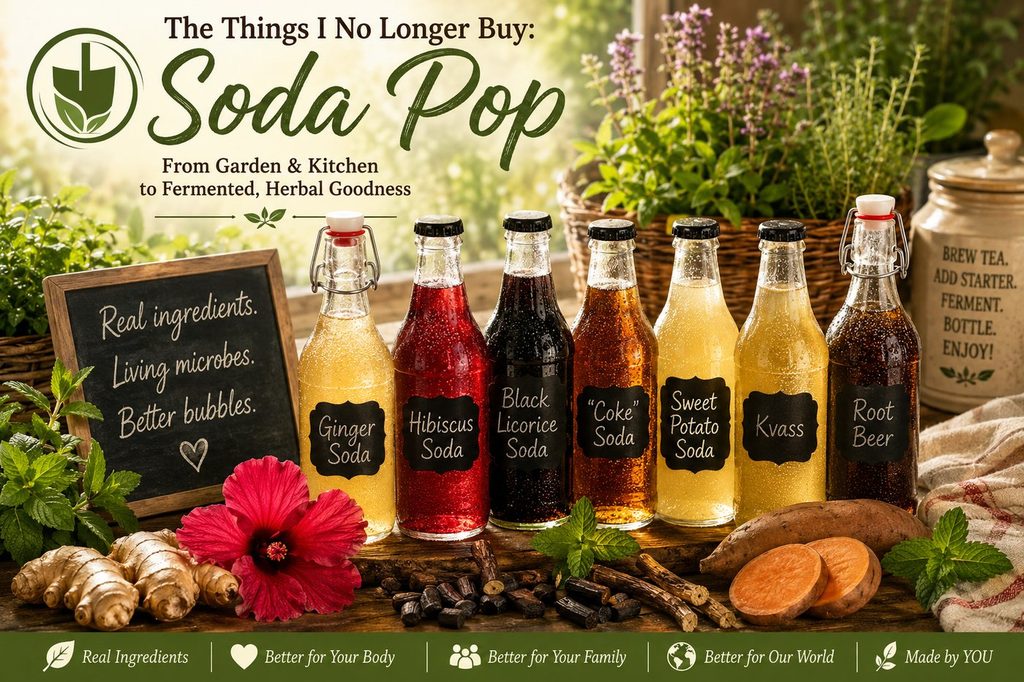
Seven Brews to Explore
Once you understand the basic technique, an entire world opens up.
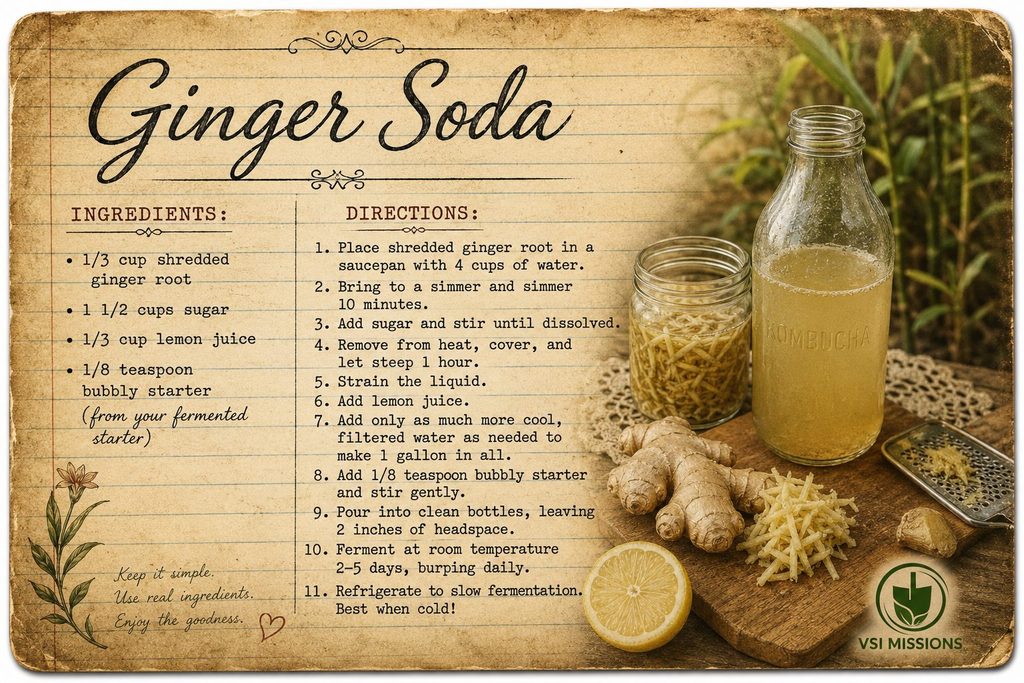
Ginger Soda
Fresh ginger, lemon and sugar make a bright, spicy soda and a wonderful place to begin. Brew the ginger strongly, sweeten it, cool it, add your ⅛ teaspoon active, bubbly sourdough starter per gallon, then ferment and bottle using the method above.
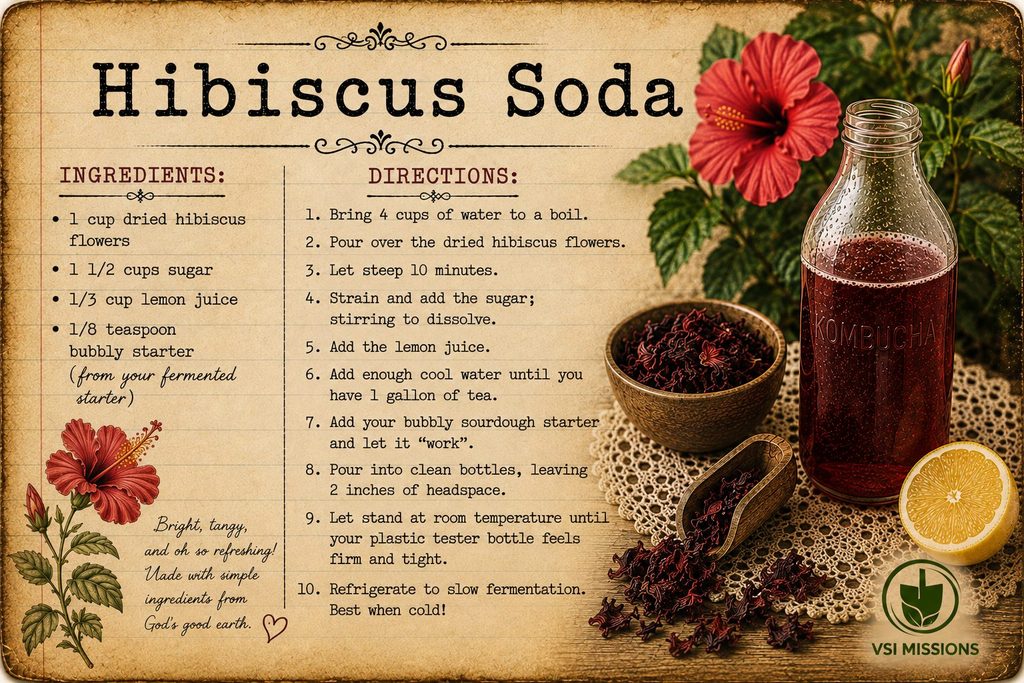
Hibiscus Soda
Hibiscus makes a beautiful ruby-red soda with a naturally tart flavor. Cinnamon or citrus can be added for another layer of flavor.
Black Licorice Soda
For black licorice lovers, I use a recipe from Stephen Cresswell’s Homemade Root Beer, Soda & Pop, then adapt it by using my sourdough fermentation method.
Rather than reproduce Cresswell’s recipe here, I recommend his book for the original formula.
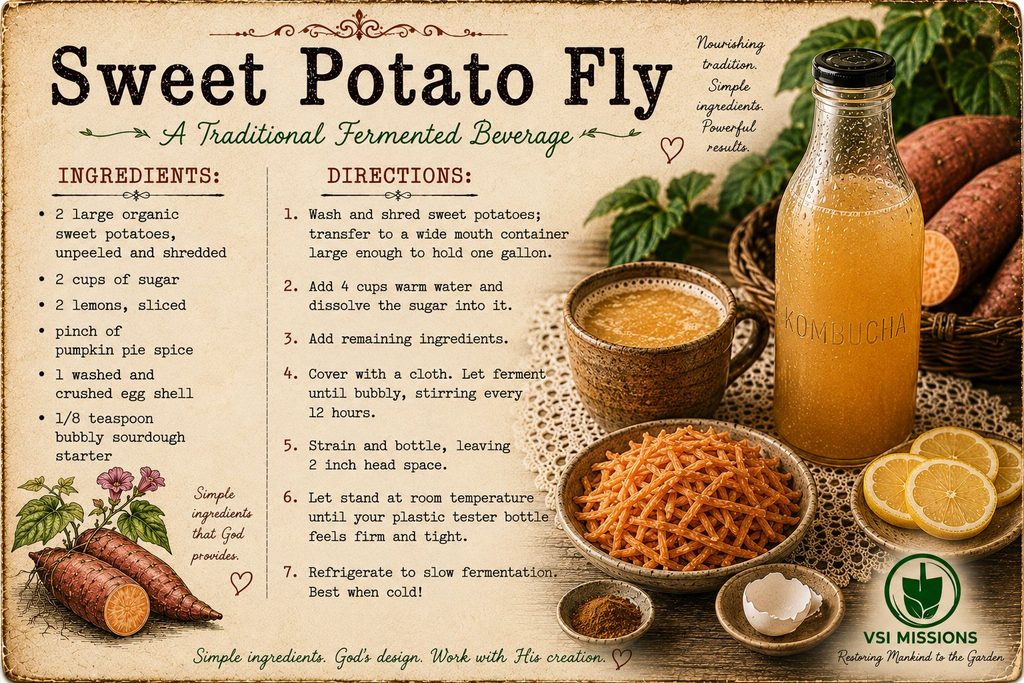
Sweet Potato Fly
Now there’s a name that gets your attention!
No, there aren’t flies in it.
Sweet Potato Fly is a traditional fermented beverage from Guyana, made from sweet potatoes, sugar and warming spices. Traditional versions vary, and my version uses active sourdough starter.
I watch for visible signs of fermentation—bubbles, movement and ingredients being lifted by the gases—rather than saying it must ferment for exactly three days.
Some traditional versions also include a clean crushed eggshell. Fermentation writer Sandor Katz notes its use; the calcium carbonate can help buffer developing acidity.
This drink has been made for generations.
We’re not inventing the brew. We’re restoring it!
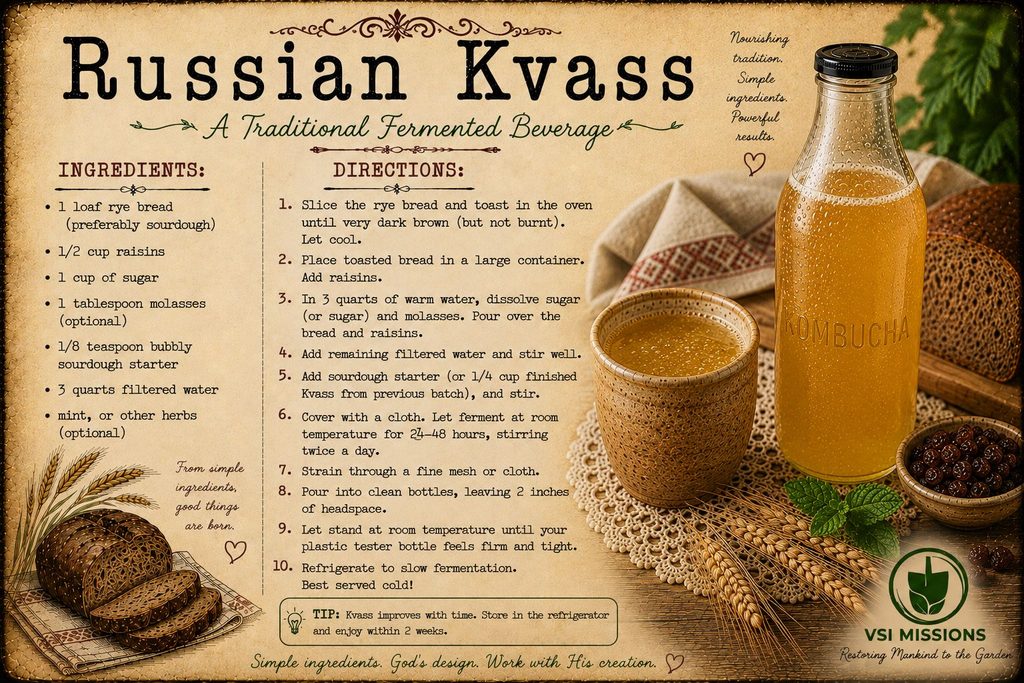
Russian Kvass
Kvass is an old Eastern European fermented beverage traditionally made with bread. Toasted stale bread, water and sugar become something completely new through fermentation.
Talk about turning scraps into something wonderful!
Homemade Fermented “Coke”
My homemade cola begins with the Curiosity Cola recipe from Andrew Schloss’s wonderful book Homemade Soda.
I prepare his cola base and then make it my own by fermenting it with active sourdough starter.
Because the original recipe belongs to Schloss, I don’t reproduce his formula here—but his book is well worth having.
Homemade Root Beer
Not growing eleven different roots, herbs and pieces of tree bark yet?
Neither is everyone else!
For an easy starting point, I use Really Root Beer Tea from Nelson’s Tea, a prepared blend of traditional root-beer herbs and spices.
For one gallon, I brew ½ cup of the tea blend into a strong tea and sweeten it with 1¾ cups dark brown sugar. Once cooled, I add ⅛ teaspoon active, bubbly sourdough starter and follow my usual fermentation method.
At that ratio, a 16-ounce bag makes approximately nine gallons of root beer.
This is an important part of self-reliance too.
You don’t have to do everything from scratch on day one.
Start where you are. Learn the skill. Grow from there.
Once You Learn the Method, Everything Looks Like Soda!
That mint spreading through the garden?
Soda.
Fresh ginger?
Soda.
Hibiscus flowers?
Soda.
Properly identified edible herbs growing wild around your property?
Maybe soda!
Suddenly making a special beverage doesn’t require walking down the soda aisle.
It might require walking into your backyard.
Think about a cold peppermint soda on a hot summer afternoon.
Delicious!
Two Books for the Budding Soda Maker
Two books I recommend are:
Homemade Soda by Andrew Schloss — This is where you’ll find the Curiosity Cola recipe I adapt for my fermented “Coke.”
Homemade Root Beer, Soda & Pop by Stephen Cresswell — A wonderful resource for old-fashioned homemade sodas and the source for the Black Licorice Soda I adapt.
Learning self-reliance doesn’t mean pretending no one else knows anything.
We learn from one another.
We practice.
We experiment.
We adapt.
And then we teach someone else.
That is how skills survive.
This Is Why I No Longer Buy Soda Pop
For me, homesteading isn’t simply about doing without.
It is about rediscovering how to do things.
There is something incredibly rewarding about serving guests a cold bottle of homemade hibiscus soda and saying:
“I made this.”
Children can harvest herbs, help brew tea, fill bottles, squeeze the plastic tester bottle and watch fermentation transform something they helped create.
And every bottle can teach something—botany, microbiology, history, food preservation, self-reliance, patience…
Maybe even a little physics if you ignore that plastic tester bottle!
We often begin these old skills because we want less:
Less processed food.
Less packaging.
Less dependency.
Less money spent at the grocery store.
But somewhere along the journey, we discover that what we gain is far greater than what we gave up.
I didn’t stop buying soda because I wanted to deprive myself of something enjoyable.
I stopped buying soda because I discovered something better.
Something I could grow.
Something I could brew.
Something I could teach a child to make.
Something I could serve to a friend.
Something that connects my garden, my kitchen and the invisible world of fermentation happening all around us.
We aren’t giving up soda.
We’re restoring the brew.
And that is the heart of The Things I No Longer Buy.
It isn’t really about what I’ve stopped purchasing.
It’s about everything I’ve learned to create instead.
So save those bottles.
Plant some peppermint.
Feed your sourdough starter.
And start dreaming about what your garden might taste like…
with bubbles.